
By Jemima Jefferson, LGB Business Forum
What’s gone wrong with DEI? With Meta, Deloitte and other well-known companies backpedalling on DEI initiatives, is corporate commitment to inclusion beginning to sour? If so, should other businesses begin following suit?
In a word, No. Representing, welcoming and rewarding everyone on their merits and ability isn’t just a moral choice; it’s sound business sense — when done sensitively and well. To understand why DEI has become so divisive, we need to look at how it’s evolved over the years, and examine the errors that crept into initiatives that were supposed to unite us.
Lesbians, gay and bisexual employees are perhaps the best qualified to explain. We’ve had a front row seat through the whole thing; we were among the first to benefit from diversity and inclusion, but we’re now suffering the consequences of DEI’s wrong turn.
Take my experience working for an investment bank. You’d expect such a hyper-heterosexual, super-masculine industry to be an intimidating place to be a lesbian, but we had a thriving LGBT staff network, full of lovely lesbians and gay men all getting to know each other, supporting each other at work, outside work, having fun, volunteering for LGB charities, raising money for them in our spare time. It felt like family.
But there was a wider purpose to this network. Our bank, along with many multi-national companies at the time, realised that winning and retaining the very best talent meant eradicating all discrimination and bias from the business. Further, it was about supporting them in real and meaningful ways.
I recall a meeting with HR about a gay male couple who were relocating to a country where it was illegal to be gay. It was a fantastic career opportunity for the employee but he wanted to take his boyfriend with him. This was before same-sex marriage – you could still legally be fired for being gay — yet the company did their best to offer policies to gay (and unmarried straight) couples that matched those offered to married people.
The network collaborated with HR to talk through all the issues involved, how the company could support this couple, where the boundaries of responsibility would be, which company policies could follow them to the new location, and which couldn’t due to local legislation; how to stay safely within local laws, and clarity about the penalties if they didn’t. It was collegiate, respectful, practical — and it worked. Everyone was happy, because everyone was equal.
What’s happened since I left D&I around 10 years ago? Quietly, without anyone seeming to notice, it morphed into DEI — with the ‘Equity’ part given prominence. For lesbians, gay men and bisexuals, it seemed like transgender activists were listened to above anyone else, with business leaders unquestioningly accepting the wilder claims of gender identity ideology. We saw the reality of ‘sex’ (which is of course fundamental to women and LGB employees’ experience) replaced with the nebulous concept of ‘gender’. No wonder so many lesbians and gay men feel uncomfortable, unvalued and unsupported.
It’s not just LGB people, either. When any male can use women’s loos and changing rooms (the logical and inevitable consequences of workplace policies prioritising ‘gender’ over sex), it discriminates against the 1 in 4 adult women who have experienced sexual abuse in their lives. (Note: that’s a government statistic; the actual figure is likely to be much higher). It also doesn’t account for the needs of women whose religion forbids them from being alone with an unknown man. And that’s to say nothing of the heterosexual men demanding to be seen as lesbians and included in staff LGBT networks.
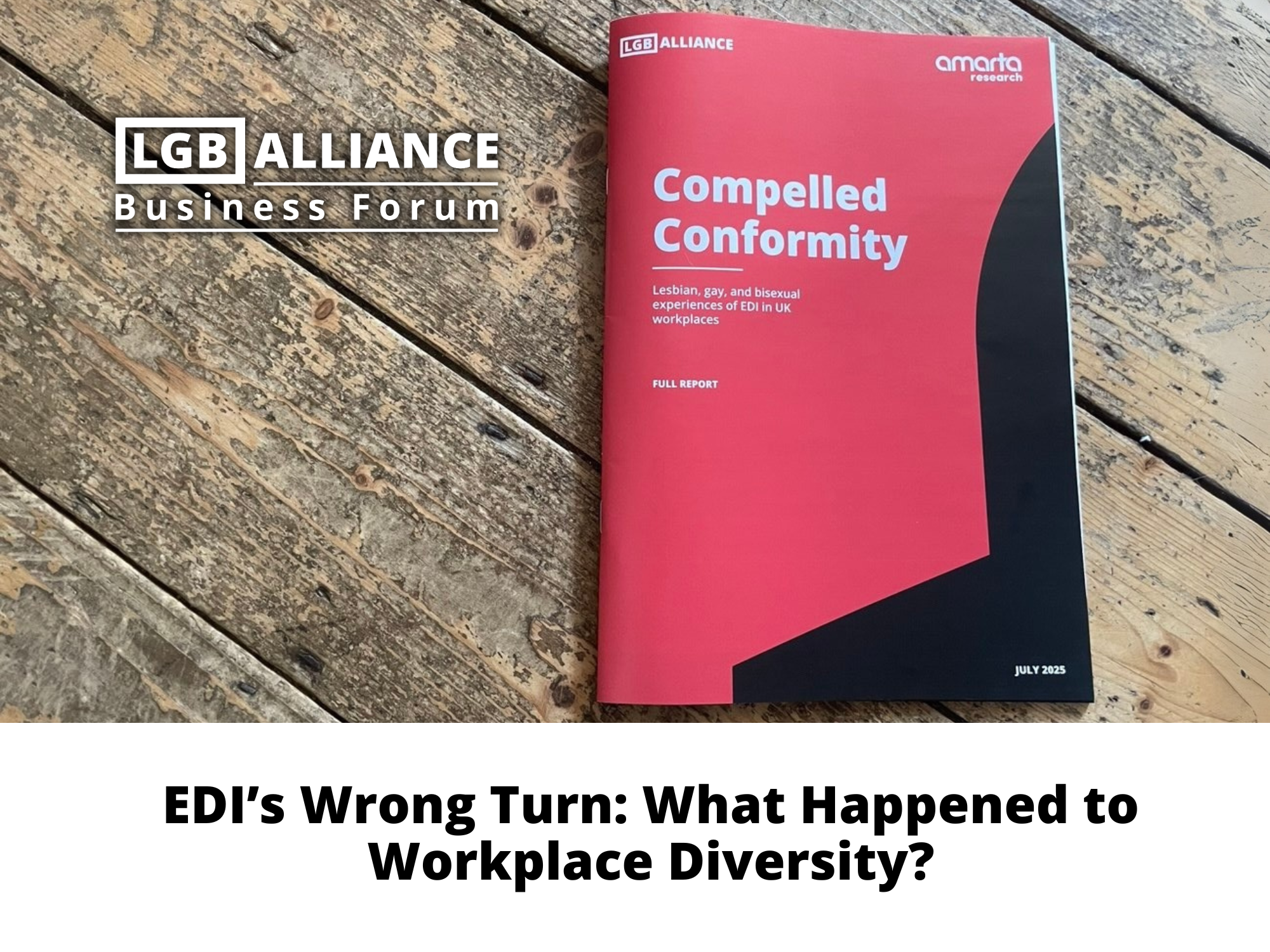
LGB Alliance’s recent Compelled Conformity report found lesbians and gay men are often silenced, frightened to speak about their rights at work – the opposite of what D&I was designed to do.
So what do we keep and what do we discard? Well as Joanna Cherry pointed out at our recent event in Holyrood, there are nine protected characteristics, and all are important. Simon Fanshawe suggested that organisations need to focus on viewpoint diversity – we all need to be able to rub along together and we do that through talking to each other and understanding different needs.
But it’s bigger than that. We need to go back to looking at the data – who do we have in our employee pool? How do we hire the best minds? And how do we keep them? Honest conversations with people from all demographics would be a good start – and I, personally, would vote for a return to Diversity and Inclusion – supporting people regardless of their background and life history to be the best, happiest employees. Because, after all, the happier you are at work, the more you feel part of a family, the better you’ll contribute to everyone’s shared success.