
By Rob Jessel, LGB Alliance Press Officer
We all know the feeling. You put weeks into preparing a public presentation, and an hour before it starts all you’re worried about is whether anyone actually turns up.
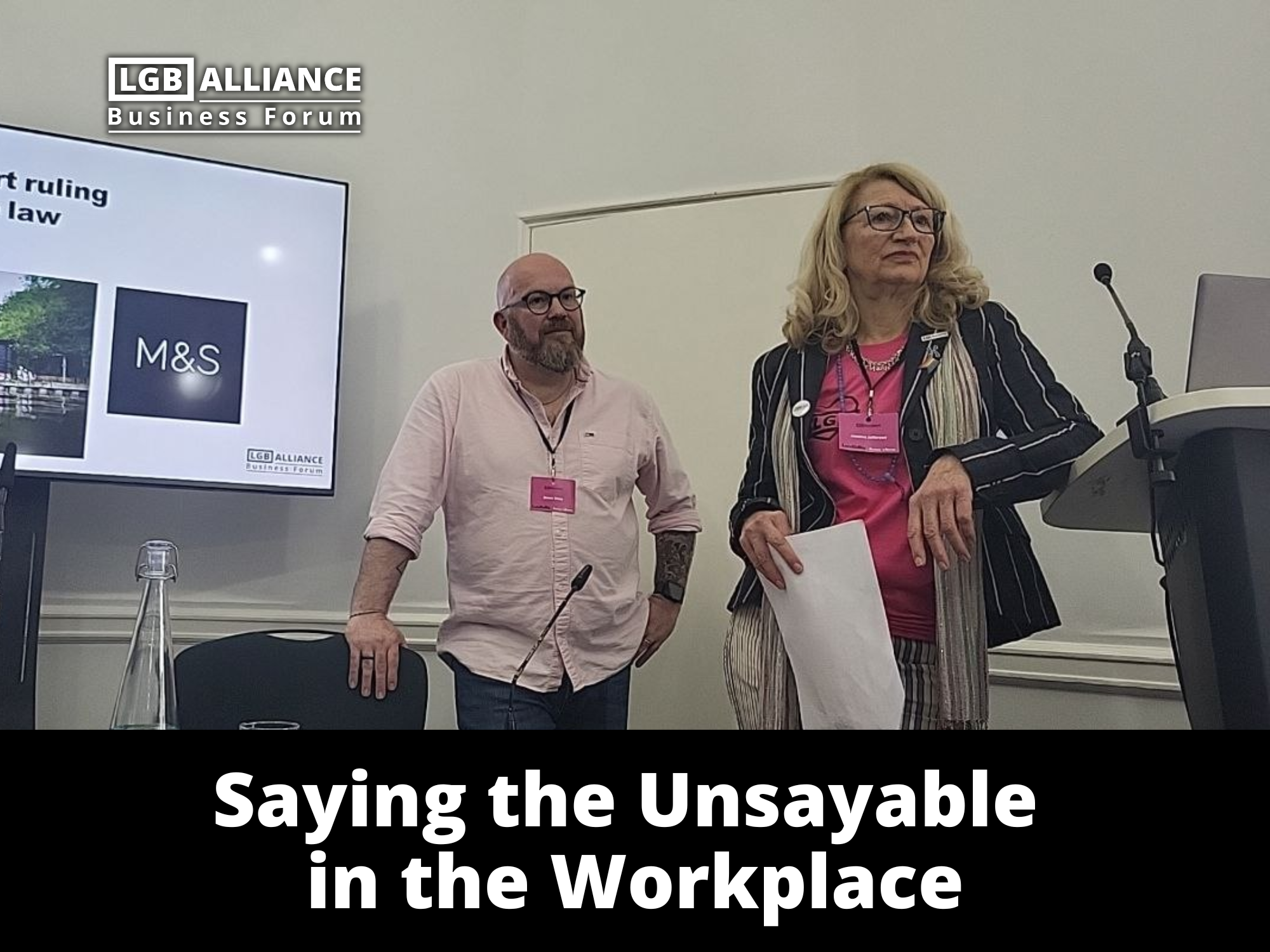
I don’t mind admitting I had butterflies before Saying the Unsayable in the Workplace, the conference panel delivered by LGB Business Forum members Simon and Jemima. And I wasn’t even presenting. But that anxiety proved completely unfounded; the standing-room-only session proved so popular, we had to lock the doors.
That’s good news – and bad. Because it confirms that the workplace is one of the last bastions of “acceptable” homophobia, and all the worse for being the place we spend most of our waking hours.
Well-attended this panel may have been, but it didn’t go entirely according to plan. Jemima and Simon had an in-depth, well-rehearsed presentation based on Business Forum’s groundbreaking Compelled Conformity report, which revealed how LGB employees feel coerced into affirming TQ+ propaganda at work. The session, however, quickly evolved into a town hall meeting, with a forest of hands springing from delegates eager to contribute their own horror stories – along with demands for more and better resources to help them fight back.
As LGB Alliance press officer (with particular responsibility for Business Forum) let me say: We hear you. All of you. And we agree: we urgently need to address the lack of support available to LGB employees who are forced to choose between their career and their conscience.
For that, we need your help. We want to collect as many workplace ‘war stories’ as possible to build a full picture of the myriad ways LGB people are daily browbeaten with TQ+ activism. The training that implicitly or explicitly brands homosexuality as ‘non-inclusive’. The ‘voluntary’ codes of conduct and the compelled pronouns. The forced-teaming, and the involuntary ‘queering’ of same-sex attracted employees; the LGB staff networks forcibly taken over by the TQ+.
Saying the Unsayable was a great start, because it got hijacked (in the best possible way) by delegates whose experience tallied exactly with our findings from Compelled Conformity.
But it wasn’t just a litany of horror stories. A golden thread ran throughout the whole discussion: the only reason the TQ+ has been allowed to rampage through the workplace is because there’s a lacuna where reliable, lawful guidance ought to be. In fact, a few attendees recounted how they’d forced a re-write of unlawful corporate policies thanks to robust, well-framed approaches to internal legal teams and HR.
That’s where we can make a real difference. If Compelled Conformity diagnosed the problem, our next step is to create a bank of legally-watertight resources that enable any employee or group to challenge unlawful organisational policies: from template letters to guidance on the Equality Act 2010 and the 2025 Supreme Court judgment; from case studies highlighting the reputational damage incurred by discriminating against lawful speech, to informal but legally-approved scripts to use in watercooler conversations.
The goal is not to inject yet more activism into the workplace, but to re-establish the boundaries eroded by years of unchallenged Queer Theory.
Fortunately, we don’t have to go from a standing start. Thanks to the pioneering work of organisations like Sex Matters and the Sex and Equality and Equity Networks (SEEN), we’ve got some great templates to work from. Yet our resources must reflect the unique experiences of LGB people, and harness the anger and frustration we feel when simply saying ‘gay’ has become the last taboo at work.
As Jemima and Simon pointed out, we can’t do this on our own. We’re infinitely more powerful when we speak with a single voice. Fortunately, there are plenty of ways to get involved. Follow us on LinkedIn (obviously); share our blogs and articles on socials and with colleagues – and keep an eye out for our soon-to-be-launched Ambassador Programme. This initiative seeks to put an LGB liaison officer in every large and medium-sized organisation to help HR and legal teams shape policies that are equitable to every employee, not just the Alphabet People who make up just 0.5% of the workforce.
And finally: we need your experiences and your expertise. If you want to contribute an article, blog or case study (pseudonymously if you prefer), or help us build our resource library, we want to hear from you.
Let’s get things moving, and together build workplaces that are finally fair for all.