
By Charlotte Cadden, LGB Business Forum
“Dear homosexual and bisexual employees. This email is to inform you there’s been a strategic re-think on diversity, and it’s been decided that same-sex attraction no longer complies with our inclusive values. Henceforth, we are updating our Pride policy, which will be re-named ‘Gay Shame’ going forward. Thank you for your compliance.”
Yeah, right. Businesses aren’t shaming employees for being same-sex attracted…are they? Well, consider this recent article in the i Paper, where HR consultant Katie Elliott recommends that people who decline to use they/them pronouns should be “shamed” until they comply.
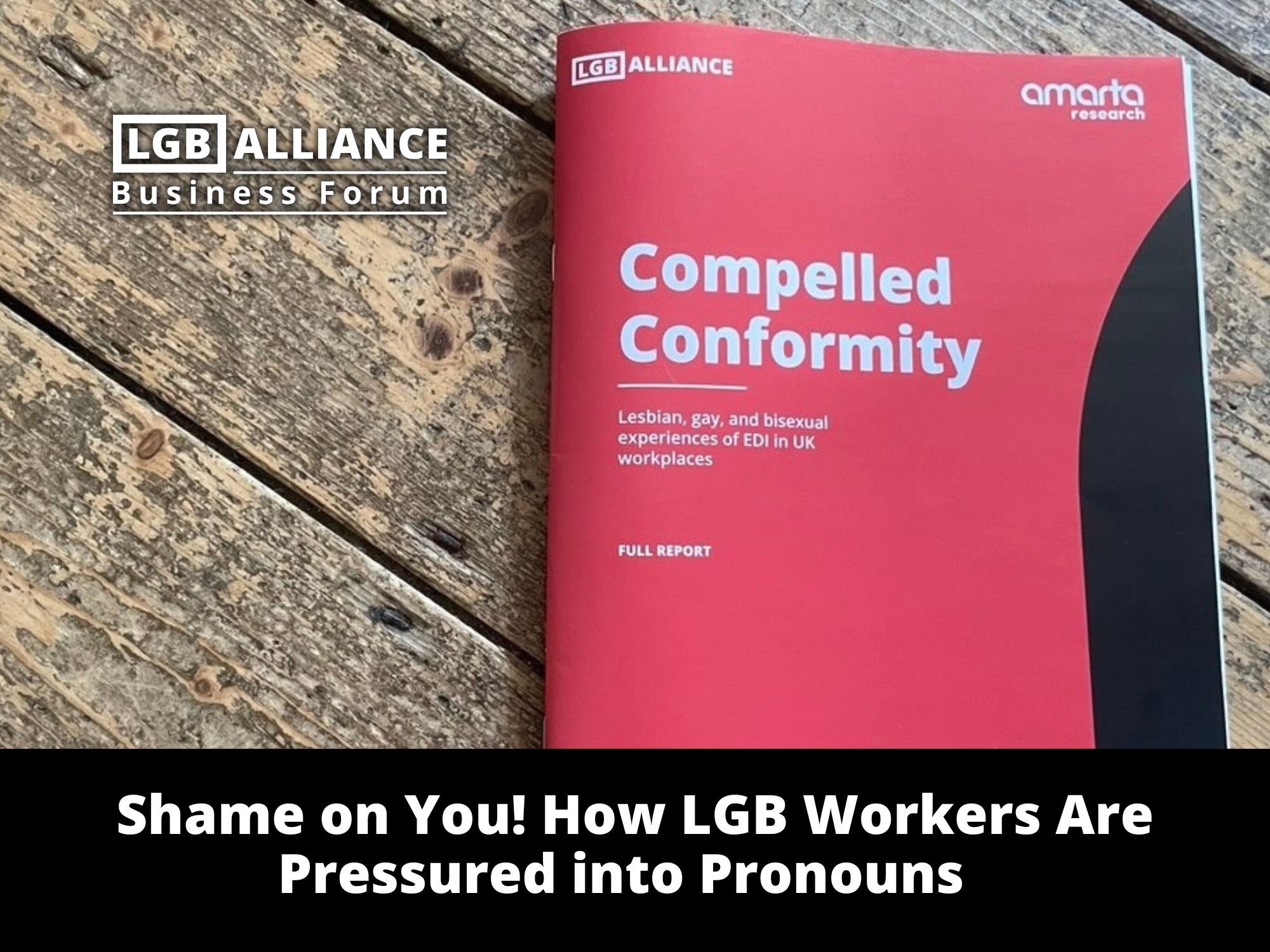
This will come as no surprise to anyone who’s read our Compelled Conformity report, which revealed that two-thirds of LGB employees have been pressured to publicly agree with political opinions they do not hold – including the use of wrong-sex pronouns (“neopronouns”). And could there be a better example of coercion than “pronoun shaming”?
Katie’s egregious appeal to shame isn’t the only thing wrong with this article; she also relies on a simplistic interpretation of the Equality Act. We’ll get to that in a moment, but before we call in the lawyers, may I suggest something radical? Shouldn’t we attempt a bit of good faith dialogue?
According to Katie, the only conceivable reasons Boomers (her word) don’t use neo-pronouns is because they don’t like change, are stubborn, or “frankly, lazy”.
In truth, it’s none of these things. It’s because pronouns signal adherence to an ideology which states that sex is less important than gender identity. Given it’s the entire basis of our sexuality, lesbians and gay men are often deeply uncomfortable with the not-so-little lie that sex is irrelevant, or something that can be opted out of at will.
I can’t believe we have to repeat this in 2026, but the opinion that sex is real, observable and important is not some fringe belief: judges have confirmed it’s a view worthy of respect in a democratic society, and of course the Supreme Court clarified that the protected characteristic of “sex” in the Equality Act 2010 refers to biological, immutable sex.
In spite of this, the demand that we respect each others’ beliefs only ever seems to go in one direction. By contrast, consider the stories from lesbians and gay men in Compelled Conformity who, when they dared to challenge the pronoun mafia, found themselves hauled before HR and told to “moderate their language”.
Katie is right about one thing, though: shame is a powerful weapon of coercion. As one lesbian in our report admitted: “I feel ashamed to self-censor…it feels like being in the closet again.”
The question for HR and internal legal teams is whether they have the appetite to wage a lengthy, bitter and divisive “pronoun war” in the workplace. Katie’s article suggests they have strong legal grounds if they choose to compel employees’ speech, since deliberately or repeatedly misgendering someone “could constitute harassment or discrimination” under the Equality Act.
This is a rather facile interpretation of a complex legal issue involving clashing rights claims; readers could be forgiven for inferring that compelled pronouns are entirely free from legal risk. In reality, it is far more nuanced and context dependent. Post-Forstater and post-Supreme Court, organisations risk being taken to tribunal if they trample upon employees’ Article 9 freedom of thought, conscience and religion
As Audrey Ludwig, Equality law consultant and non-practicing solicitor notes, there are two main problems with Ms Elliot’s proposals. “Firstly, it is far from legally correct that misgendering” is always unlawful harassment,” she told me. “Indeed, last year a woman with dyspraxia won a disability discrimination claim for being disciplined for ‘misgendering’.
“Secondly “shaming” someone (as opposed to management taking a proportionate response which recognises all sides rights and context could itself be unlawful discrimination or harassment.”
Isn’t it better not to involve the lawyers at all? We would argue that a little mutual understanding could go a long way to bridging the divide. Rather than smearing LGB people as bigots for declining to use neo-pronouns, employers could consider…listening to us? If that sounds like an idea, you know where to find us. We’d love to talk.
That’s not a demand, by the way – just a polite request to engage. And please, try not to shame us back into the closet.